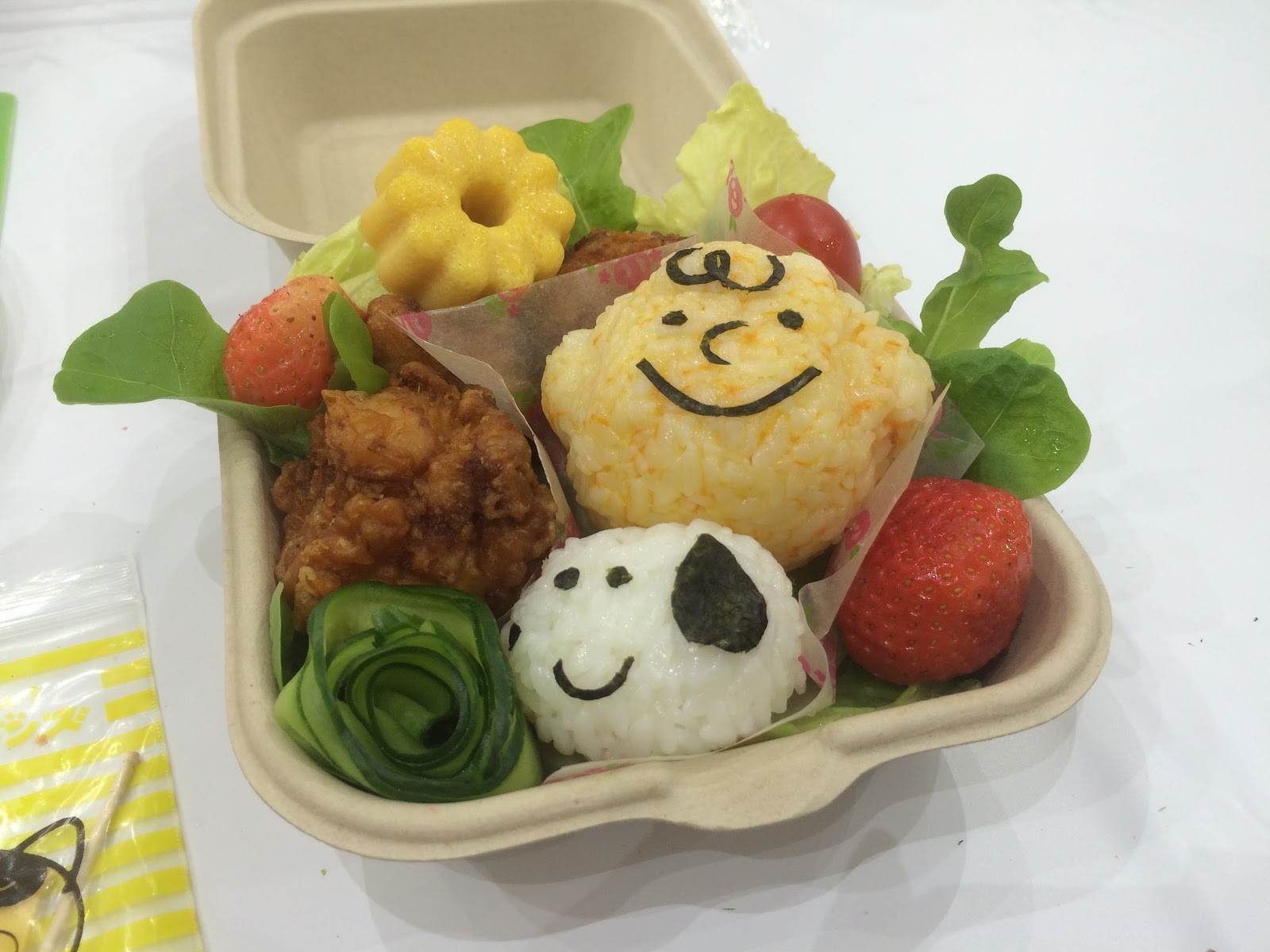
Breakfast:


That is raw tuna with green onions and sauce.
Side note: I keep seeing pictures of baby Dorey online and they're adorable. It's killing me that I'm not going to get to see that movie for months. I don't even care whether or not the plot turns out to be good, I just want to see more baby Dorey.
Onigiri #10 during our long break:

Lunch from 7-11:

 The bread was "Cream Bread" so I expected a tiny dollop of something in the middle. I was surprised and not at all unhappy to find out it was almost completely filled with custard. As in, the bread was a shell about half an inch thick, and everything else was essentially cream pudding. Also, Onigiri #11.


I also got an aloe and white grape juice from the vending machine. It was really sweet, but also very light and refreshing, and kind of reminded me of the elderflower juice from IKEA. Also, there were small chunks of aloe at the bottom which startled me because I didn't get any until halfway through.

After lunch we had our second Special Lecture. Our guest speaker was Michael Molasky who is from the U.S. and teaches at Waseda University in Tokyo.
He talked Izakaya (sort of like Japanese pubs) and what they are like as spaces, the uniqueness of the small communities that form between regulars, and about how a lot of them are losing that culture by either being replaced by chain restaurants or becoming popular online and flooded with non-regulars to the extent that sometimes long-time customers have difficulty getting a seat.
Some of the unique things he talked about were that in these spaces: social status outside the Izakaya doesn't really matter (which is huge in a country where even a years difference in age may change the level of formality you speak with), you aren't strangers with the other regulars but keep a comfortable distance, you are welcomed but not expected to show up, any conversation held at the bar seating is considered public information which strangers may listen to or comment on.
Four more interesting things:
First, Japan has a lot of highly specialized and subcategorized types of food-serving places. For example, ramen, udon, or soba restaurants may only serve ramen, udon, or soba respectively even though they are all noodles. This likely came from when people would sell their food from carts or mats and could only sell one thing. Many of these businesses eventually moves into buildings, but continued to only sell that one type of food.
Second, スナック・バー (snack bars) are bars that also serve small portions of food. The food isn't always the best, but it doesn't have to be. These spaces became popular when there was a law that bars had to close at midnight. By also serving food, these places could stay open later.
Third, Jazz Cafes are kind of the opposite of the Izakaya in that talking is usually discouraged. Some even have no chatting policies and you can only talk to order etc., though this is less common now. The reason for this was that in the 60's and 70's jazz was huge and you went to these places to listen to the live music more than anything else, and most people were pretty serious about it.
Finally, he gave us some advice about talking about Japan (or other countries, cities, cultures, etc. but Japan is the relevant example so I'm sticking with that). When you get back to wherever you're from and people ask you "How was Japan?" it can be difficult to not make the country sound completely homogenous while still giving a concise answer. He suggested trying to focus on, or at least mention, differences within the country itself. For example, differences in customs between two cities. This way it's easy to give an impression of how dynamic the country is without giving way too long of an answer.
After this, I went to a Kyudo trial at a nearby high school (the same one that had the tea ceremony). Kyudo is basically Japanese archery.
Seven or eight of us were all on the same city tram and when we got to our stop we took too long to get moving towards the front and the tram started going again with us still on it. We ended up having to get off at the next stop and walk a few blocks back to the school.
Here is the range:

Here is the glove we wore:


We got to learn how to shoot arrows on the bow (which are crazy tall), and then each got to shoot once with the help of the instructor (who is actually one of my friend's host dad). I'm really glad he was there helping us and covering some peoples ears when they shot because apparently if you hold the bow wrong you can slice your ear off.
Some people's arrows got really close to the targets, most people's didn't make it to the targets. I was quite solidly in that latter group of people.
Here is the instructor demonstrating:


While waiting for the bus my friend pointed out these squid which have either been sitting outside for days and are still alive, or are replaced every day or two. I'm guessing they are replaced, but could be wrong.

I had about an hour before my bus got there, so I walked around a convenience store for a while and got some melon chewy candies and some ice cream hard candies. Here are the melon candies:

They were pretty good, but not as good at the matcha caramels and were kind of like a hi-chew but with a little less flavor and a lot more chewiness.
Dinner and dessert:


The stuff in the light blue bowl is called 心太(ところてん)(tokoroten) and are jelly strips made from agar. They were flavorless, but had a fun texture and were served in some kind of good-tasting, thin, brown, sauce. I couldn't figure out what it was at the supermarket because the way it was packaged and because the strips are transparent it just looked like a container of water. My host mom saw me looking at them and got some.
For dessert we had ice cream with dango. Dango is made of rice flower dumplings and are often served with various sauces. We had dango with red bean paste (not pictured) and the ones in my ice cream had some sort of caramely sweet topping. They are delicious on their own, and the ice cream just brings them up to a whole new level of amazing.
Here are the ice cream hard candies:


The flavors were: Rum Raisin, Chocolate Mint, Caramel Ribbon, and Very Very Strawberry.


I didn't think I was going to like the raisin one, but I think it's my favorite because it tastes kind of like a cinnamon roll. I'm not crazy about the mind one -- it's a little too close to toothpaste flavored -- but the caramel and strawberry ones are both nice.